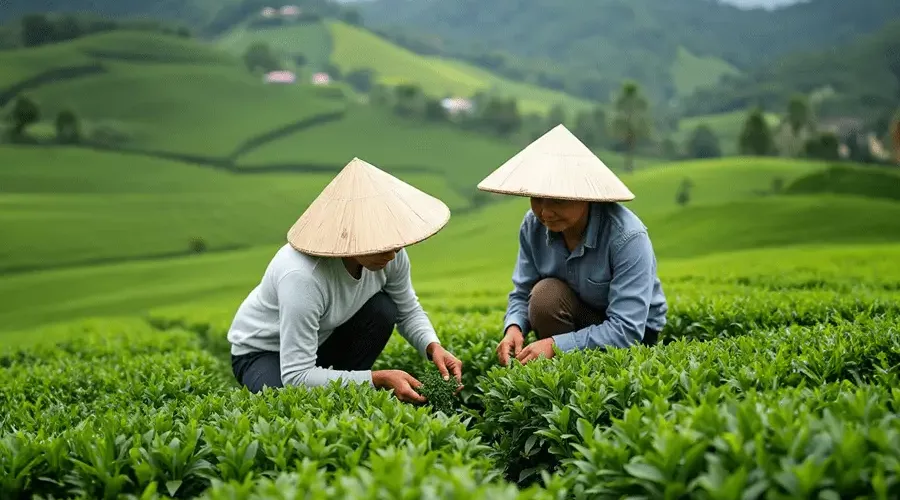
A matcha, that powdered green tea with its vibrant emerald color and umami flavor, has been Japan's exclusive heritage for centuries. But demand is outstripping production. Matcha beyond Japan: new producing countries This is an article in which we aim to reflect on alternatives to the Japanese market as a potential lifeline to a situation that, for the time being, shows no signs of improvement.
Matcha beyond Japan: The main alternatives
Matcha in Japan: origin, tradition and excellence
Japan not only perfected the technique of growing and grinding green tea, but also knew how to integrate it into a philosophy of life. The combination of temperate climate, volcanic soils and traditional methods shading and grinding make it the absolute benchmark in quality.
But demand far exceeds Japanese production capacity, opening the field to new global producers.
Matcha in China: Large capacity, evolving quality
Although the origin of ground tea is in China, its development as modern matcha has been more recent. Regions such as Zhejiang They produce large quantities, but their quality is often geared toward industrial uses or low-cost blends. Still, some producers are working to approach Japanese standards.
Advantages:
High production volume.
Competitive prices.
Disadvantages:
Variable quality and sensory profile.
Low perception of authenticity among demanding consumers.
Matcha in South Korea: Refinement Underway
In places like Jeju IslandSouth Korea has found a similar environment to Japan. The country is committed to sustainable, high-quality techniques, focusing on small-scale productions that prioritize flavor and traceability.
Advantages:
Favorable climate and soil.
Committed to quality and organic production.
Disadvantages:
Limited production and specific experience in matcha.
Less international recognition.
Matcha in Taiwan: elegance at altitude
Taiwan is famous for its high-mountain teas, and some producers are applying that experience to matcha cultivation. Although still in the exploratory phase, teas with very interesting aromatic profiles have been developed.
Advantages:
Experience in quality teas.
Constant innovation.
Disadvantages:
Low volume.
Little specific infrastructure for matcha.
Matcha in Vietnam: Growing Production and Global Access
Vietnam is one of the world's largest tea exporters. In recent years, it has begun producing matcha mainly for export, with average quality and competitive prices. Some cooperatives are beginning to improve their processes to reach the premium segment.
Advantages:
Skilled and abundant labor.
Low production costs.
Disadvantages:
Reputation still developing.
Needs to improve shading and fine grinding techniques.
Matcha in Thailand: Tropical flavor with potential
Northern Thailand, especially the mountainous areas of Chiang Rai and Chiang Mai, is positioning itself as a new matcha-producing region. With a focus on organic farming and fair trade, some Thai batches are surprisingly sweet and smooth.
Advantages:
Favorable climate and altitude.
Focus on Western markets with ecological interest.
Disadvantages:
Still in the early stages of technical development.
Direct competition with other Thai teas (oolong, black).
Matcha in the United States: innovation and proximity
Hawaii and parts of California are beginning to cultivate Camellia sinensis to produce local matcha. While far from Japanese quality, they stand out for their organic approach and local consumption.
Advantages:
Organic certifications.
Consolidated domestic consumption.
Disadvantages:
High costs and little experience.
More irregular climate for this crop.
Matcha in Europe: a dream yet to be achieved
European interest in matcha is not limited to consumption. Countries such as Spain (Galicia or Catalonia), Italy or Portugal They are experimenting with small farms and artisanal production models. Climate and soil conditions are still a challenge, but the market increasingly values the local origin and sustainability.
Advantages:
Proximity to the consumer.
Growing interest in ecological and artisanal products.
Challenges:
Long learning curve.
Difficult competition with Asian producers.
Conclusion: Matcha is going global, but Japan remains the soul
The world of matcha is booming. Japan continues to set the standard in quality, tradition, and flavor, but countries like Vietnam, Thailand, South Korea and Taiwan They are demonstrating that there is life beyond the Japanese archipelago. At the same time, the United States and Europe are proposing new production models that are more local, sustainable, and adapted to their own markets.
The future of matcha will be global, but the essence will remain profoundly Japanese.